A bar is not a slow-paced restaurant with a shorter menu. It’s one of the fastest, highest-volume-per-square-foot environments in hospitality, running on a completely different rhythm than table service: open tabs stacked three deep on a busy Friday, a bartender ringing in a round of five different drinks in under a minute, pour costs that can make or break margin on a single bottle, and a legal obligation to verify age on every single transaction without exception. A POS built primarily for retail or full-service dining, with a bar module tacked on, tends to show its seams exactly at the moments a bar can least afford it — last call on a packed Saturday.
Here’s what actually matters for bar and nightlife POS technology heading into 2026, and where generic systems tend to fall short.
Speed at the Rail Is the Whole Game
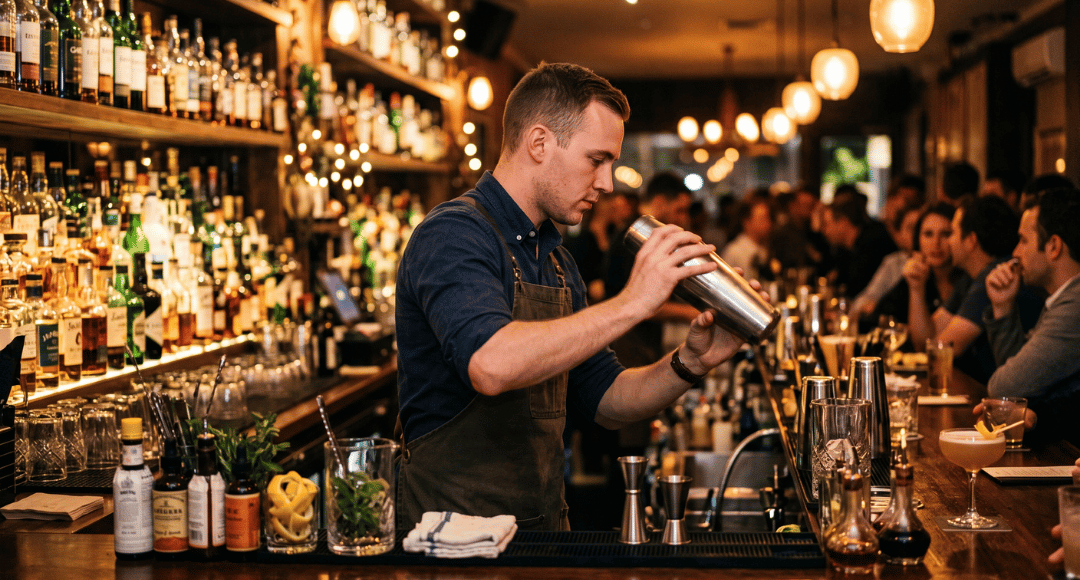
Everything about bar service is compressed into seconds. A bartender working a busy rail needs to ring in an order, run a tab, close a tab, and move to the next customer — repeatedly, for hours, without the interface ever slowing them down. A POS with too many taps required to complete a common action, or a menu structure that buries frequently-ordered items behind categories built for a food menu rather than a drink list, creates real friction that compounds across hundreds of transactions a night.
What actually matters here: a customizable, drink-first layout that puts the most-ordered items front and center rather than nested in generic categories; the ability to open, modify, split, and close tabs quickly without navigating away from the current screen; and hardware that can survive the actual physical environment of a bar — spills, crowding, low light — without becoming unreliable exactly when it’s busiest.
Tab Management Is Different From Table Management
A restaurant’s POS is built around tables — a party sits down, one ticket, one bill, done. A bar’s real unit of business is the open tab, and tabs behave very differently: a single tab might get added to across multiple bartenders and multiple hours, a tab might need to be split unevenly across a group at the end of the night, and a bar frequently has far more open tabs simultaneously than a restaurant has active tables. A POS that treats tabs as a first-class object — easy to find, modify, split, and close from any terminal, not just the one where it was opened — avoids a huge source of end-of-night friction and lost time reconciling who owes what.
Pour Cost and Inventory Tracking Are Margin, Not Just Housekeeping
In a bar, liquor cost as a percentage of sales is one of the most closely watched numbers in the business, and it’s also one of the easiest to lose control of without the right tracking. Over-pouring, comped drinks that aren’t logged consistently, and simple shrinkage all erode margin in ways that are hard to see day to day but add up significantly over a month. A POS with real inventory tracking down to the bottle or pour level — not just broad category totals — gives an owner or manager visibility into whether actual liquor cost matches what it should be based on sales, and flags the gap early rather than discovering it at a disappointing month-end reconciliation.
Age Verification Isn’t Optional, and Speed Still Matters
Every single alcohol transaction requires age verification, full stop — but that requirement can’t come at the cost of slowing down service to a crawl during a rush. The businesses that handle this best build ID checks into the natural flow of the transaction rather than treating it as a separate manual step bartenders have to remember on top of everything else. This matters for compliance risk (checking IDs consistently, not just when a customer looks obviously young) as much as it matters for speed.
What a Modern Bar POS Actually Needs, Concretely
- A drink-first, customizable order screen that reflects how your specific bar actually sells, not a generic template built for a full food menu.
- Fast, flexible tab management — open, modify, split, transfer, and close tabs from any terminal without losing track of who’s on what.
- Pour-level or bottle-level inventory tracking, not just broad category totals, so pour cost variance is visible before it becomes a real margin problem.
- Built-in age verification workflows that don’t slow down the transaction.
- Durable, spill-resistant hardware built for the actual physical conditions of a bar environment, not a retail counter.
- Fast tip and gratuity handling integrated directly into the checkout flow, since tip-heavy transactions are the norm rather than the exception.
- Multi-terminal sync, since most bars run more than one register or handheld device simultaneously and need them all reflecting the same real-time tab and inventory data.
Where Delta1st Fits
Delta1st’s PAX On-The-Go hardware — a mobile, WiFi- and 4G-connected smart terminal with a built-in thermal printer — is well suited to the mobility a busy bar floor demands, letting staff take orders and close tabs without being tied to a fixed terminal. Combined with Delta1st’s core inventory management (tracking up to 10,000 products, active and inactive) and multi-location oversight for bar groups running more than one location, the underlying platform is built to handle the volume and pace bars actually operate at. The bars industry page frames this around unbeatable pricing and a tailored setup rather than a one-size-fits-all retail template, which matters because a bar genuinely does need a different configuration than a boutique or a quick-service counter running the same base software.
A Few Questions Worth Asking Before Switching (or Sticking With) a POS
- How many taps does it take your bartenders to ring in your five most common drink orders?
- Can a tab be split unevenly across a group in under 30 seconds, from any terminal?
- Does your current system track inventory at the bottle/pour level, or only in broad categories that hide variance?
- Is age verification built into the transaction flow, or does it depend entirely on staff remembering to check manually every time?
- Would your hardware survive a spilled drink at 1am on a Saturday without needing a reset?
The Bottom Line
Bars run on speed, tab complexity, and pour-cost margin in a way that’s genuinely different from both retail and full-service dining — and a POS that was designed primarily for one of those other formats, with a bar mode added later, tends to show it exactly when the bar is busiest. The right setup isn’t about having more features; it’s about the specific handful of features — fast tab handling, pour-level inventory, built-in age verification, durable mobile hardware — actually being built for how a bar operates, not adapted from something else.
Your bar moves fast. Your POS should move faster. From streamlined tab management and mobile payments to inventory visibility and multi-location control, Delta1st delivers POS solutions built around the demands of your business. Stop letting outdated technology slow down service and cut into your margins.
Contact Delta1st today to discover a smarter, faster way to run your bar.